

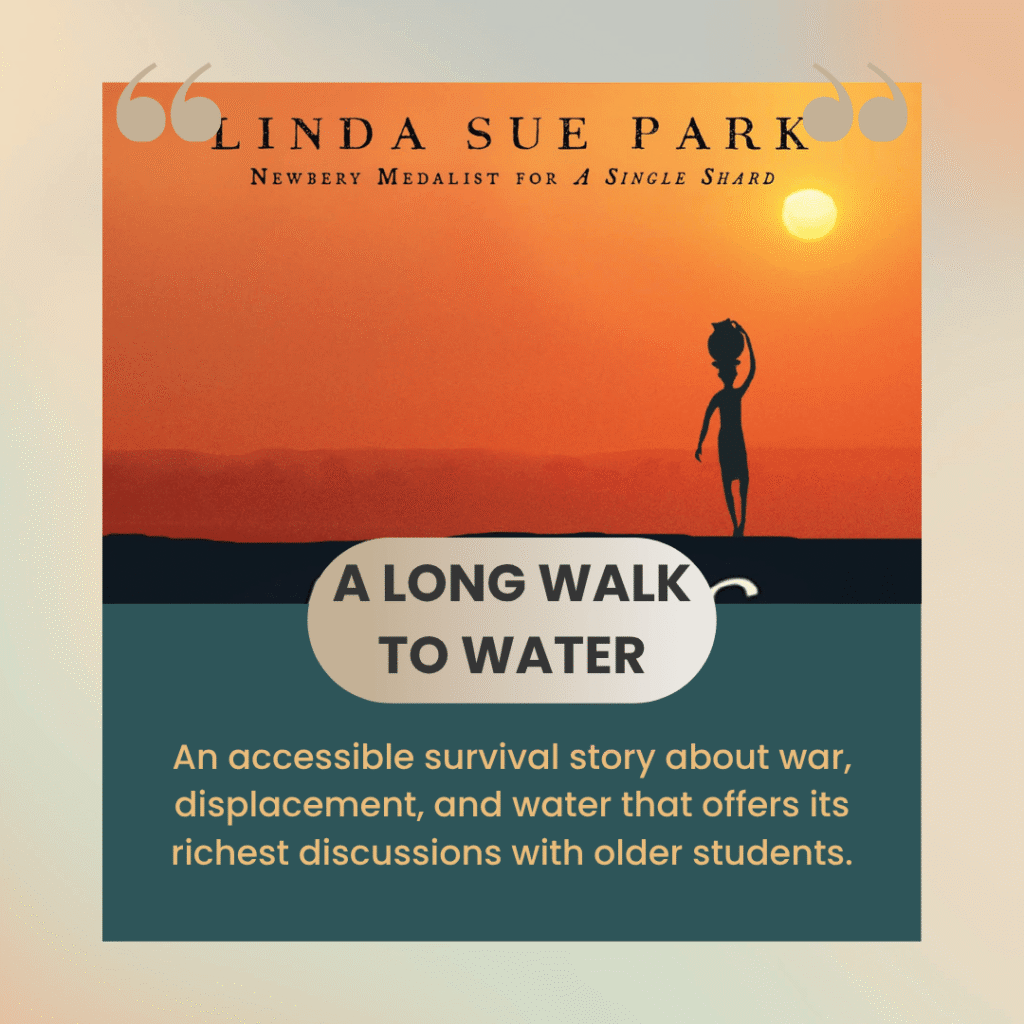
Teaching A Long Walk to Water: Grade 8–9 Teacher Prep
I liked A Long Walk to Water by Linda Sue Park, but I had a slightly different experience reading it because I had just finished Refugee and Ground Zero.
Both of those books use separate storylines that eventually connect, so I figured out pretty early that the two narratives in A Long Walk to Water were going to come together somehow.
That didn’t ruin the book for me, but it did make the structure feel more predictable than it probably would have if I had read it on its own.
Even so, there is a lot here.
This is a story about war, displacement, survival, hunger, thirst, family separation, death, and access to clean water.
And although I think many Grade 8 students could handle the content, I actually think this is one of those books that may work even better in Grade 9, not because younger students can’t read it, but because older students may be able to have much richer conversations around what the book is really asking them to think about.
As always, spoilers ahead.
If you’re thinking about teaching A Long Walk to Water, here is what I would want to know first.
What Is A Long Walk to Water About?
The novel follows two different young people in Sudan.
Salva’s story begins in 1985.
He is a schoolboy when war reaches his village and forces him to run.
From that moment on, much of his life becomes about survival.
He is separated from his family, joins groups of other refugees, travels enormous distances, experiences hunger and thirst, and watches people around him die.
Nya’s story takes place years later.
Her daily life revolves around walking long distances to collect water for her family.
The water is not clean, but it is necessary.
She makes the trip again and again because her family depends on it.
At first, the two stories seem completely separate.
Eventually, we learn how they connect.
Salva grows up and helps bring a well to Nya’s community.
I Figured Out the Connection Pretty Early
Because I had just read Refugee and Ground Zero, I was already expecting the separate timelines to eventually intersect.
So I started looking for the connection almost immediately.
That made the reveal less surprising for me.
I don’t think that’s really the book’s fault.
It was probably just the timing of when I happened to read it.
For students who haven’t recently read several books with this same structure, the connection may land much more strongly.
And even when students do predict it, that doesn’t necessarily make the book less useful.
Sometimes predicting a structural choice can actually lead to a good discussion about how an author builds connections between different lives, places, and time periods.
If your students enjoyed the multiple timelines in Refugee or Ground Zero, this would be an obvious comparison text.
Salva’s Story Is a Survival Story
Salva goes through an enormous amount.
His family is torn apart by war.
He has to leave home without knowing where most of them are.
He walks for days and weeks.
Food is scarce.
Water is scarce.
People around him are exhausted, frightened, and dying.
The entire journey forces him to keep moving even when stopping would be easier.
This is where I think the book becomes much heavier than its length or reading difficulty might suggest.
It is not a difficult book to decode.
It is a difficult book to think about.
Hunger and Thirst Are Constant
The physical survival elements are relentless.
Characters go without enough food.
They go without enough water.
They are forced to keep travelling while exhausted.
The descriptions are not written like a horror novel, but the suffering is constant enough that teachers should know the emotional tone before assigning the book.
Students may be especially struck by how basic the needs are.
This isn’t about wanting comfort.
It is about needing enough water to stay alive.
That can lead to some powerful conversations around privilege, access to resources, and how differently daily life can look depending on where someone lives.
Crocodiles and Other Physical Dangers
There are also scenes involving animal danger, including crocodiles.
The river crossing is particularly frightening because characters are already exhausted and vulnerable.
The danger is not hypothetical.
People are killed.
That is one of those scenes that students may remember because it is so immediate and visual.
Again, I wouldn’t call the book graphic in an adult sense, but I would absolutely warn teachers that death is not rare in this story.
Death Is Everywhere
This is probably one of the biggest content warnings.
People die from:
- War
- Hunger
- Thirst
- Exhaustion
- Animal attacks
- Violence
Salva loses people repeatedly.
That matters.
Students are not just following one dramatic event.
They are watching a child survive a world in which death becomes normal.
For some students, that may feel emotionally heavy even if they can technically read the book easily.
For another middle school text that also asks students to think about children living through war and displacement, Refugee is an obvious comparison.
Family Separation
Salva spends much of the story not knowing where his family is.
That uncertainty becomes part of his survival.
He has no idea who is alive.
He has no idea whether he will ever see them again.
That is important because family separation can be especially difficult for students who have their own experiences with immigration, foster care, displacement, grief, or separation.
I would want to know my students before using this as a whole-class text.
Nya’s Story Is Much Quieter, but That Is the Point
Nya’s storyline is not as action-heavy as Salva’s.
She walks for water.
Then she walks again.
And again.
That repetition is deliberate.
Her life is shaped by something many students may rarely think about:
What if getting water took hours every single day?
The repetition shows how much time is lost to survival.
School.
Work.
Rest.
All of those things are affected when basic resources are difficult to access.
That contrast between Salva’s dramatic survival story and Nya’s repetitive daily struggle gives the book a lot of depth.
Water Is More Than a Symbol
Water is obviously central to the novel.
But I wouldn’t reduce it to a simple symbol-analysis exercise.
For Nya, water is not metaphorical.
It is survival.
Dirty water can make people sick.
A well changes more than convenience.
It changes health.
Time.
Education.
Community possibilities.
That is where I think Grade 9 students may be able to go much deeper.
They can start talking about infrastructure, inequality, development, access to resources, and what happens when something as basic as water is not equally available.
Why I Think Grade 9 May Be the Strongest Fit
I can absolutely see Grade 8 students reading this book.
The reading level is accessible.
The chapters are short.
The structure is manageable.
The content is not so graphic that I would automatically say no.
But I think the discussion potential may be stronger in Grade 9.
Grade 8 students could talk about survival, courage, and hardship.
Grade 9 students may be more ready to move into questions like:
Why do some communities lack access to clean water?
How does war affect infrastructure?
How does displacement affect education?
What responsibilities do wealthier countries have?
What is the difference between charity and long-term structural change?
That’s where I think the book becomes much richer.
So for me, this is not really about whether Grade 8 students are emotionally ready.
It’s more about whether the class is ready to take the conversation beyond:
“Salva went through something terrible.”
Why I Wouldn’t Use It as a Casual Book Club Choice
This is where my recommendation may be a little different.
I would not automatically put A Long Walk to Water into a general literature-circle or book-club bin.
The book is accessible enough that students could read it independently.
But I think too much could be lost without teacher guidance.
There are so many opportunities for historical, geographical, social, and ethical context that I would rather be present for those conversations.
That is why I see this more as:
a teacher-guided class text
or
a mature-reader selection that is intentionally recommended
rather than something I would casually leave in a book-club rotation.
Would I Leave It on the Classroom Shelf?
Probably not as a completely open, grab-anything option.
That doesn’t mean I think students shouldn’t read it independently.
It means I would rather know who is reading it.
If a mature Grade 8 or Grade 9 student was interested, I would absolutely recommend it.
But because of the repeated death, war, starvation, thirst, displacement, and trauma, I would rather have a quick conversation with the student first.
That makes this a mature-read section book for me.
What Teachers Should Know Before Using A Long Walk to Water
Teachers should be prepared for:
- War
- Gun violence
- Family separation
- Refugee displacement
- Hunger
- Severe thirst and dehydration
- Death
- Animal attacks, including crocodiles
- Children in danger
- Exhaustion
- Grief
- Trauma
- Unsafe drinking water
- Illness
- Extreme poverty
- Repeated survival situations
The book is not especially graphic.
But the suffering is frequent.
That is the bigger concern.
Grade 8 or Grade 9?
My recommendation would be:
Grade 8
I would use it selectively.
It could work as a teacher-guided class text, especially with a mature group.
I would also consider it for a mature-read section where students know they can ask me about it before taking it.
What I would not do is throw it into a general Grade 8 book-club rotation and assume students will naturally get everything out of it.
Grade 9
This is where I think the book gets more interesting.
The reading level may be easier than some Grade 9 texts, but the discussion level does not have to be.
In fact, that can be an advantage.
Students can spend less energy decoding the text and more energy thinking about:
- War
- Displacement
- Access to water
- Infrastructure
- Inequality
- Refugees
- Resilience
- Development
- Responsibility
An easier text can still support sophisticated thinking.
Comparing It With Refugee and Ground Zero
Because I read all three so close together, I couldn’t help comparing them.
Refugee hit me emotionally the hardest.
Ground Zero felt deeply personal because I remember 9/11.
A Long Walk to Water felt quieter and more reflective.
It did not surprise me in the same way because I anticipated the storylines connecting.
But it still gave me a lot to think about.
All three books ask students to look at how large historical events affect individual people.
That makes them natural companion texts even though the stories are very different.
Other Books That Could Connect Well
If students connect with the survival and displacement themes, Refugee is probably the strongest next read.
For war and trauma from a very different perspective, Ghosts of War would also connect well.
If you are building a history-focused unit where students examine how major events affect ordinary people, The Boy on the Wooden Box or The Berlin Boxing Club could also fit.
Suggested Discussion Questions
I would definitely include discussion questions with this one because the real value is in what students can talk about after reading.
- Why does Salva keep moving even when he is exhausted?
- How does war change Salva’s childhood?
- What kinds of loss does Salva experience?
- Why does Nya’s daily walk for water matter so much to the story?
- How does access to water affect education?
- How does access to water affect health?
- Why do you think Linda Sue Park tells Salva and Nya’s stories together?
- When did you first predict the two stories would connect?
- Did predicting the connection change your reading experience?
- What does survival mean in Salva’s story?
- What does survival mean in Nya’s story?
- How are those ideas different?
- What responsibilities do communities or governments have to provide clean water?
- How does war affect more than just the people fighting?
- Why is Salva’s later work important?
- Is resilience something people choose, or is it sometimes something they are forced into?
- Why might an accessible book still support complex discussion?
- How does the novel change the way we think about something as ordinary as turning on a tap?
That last question could be especially powerful because it connects the book directly to students’ everyday lives.
Final Thoughts
I liked A Long Walk to Water.
It is a strong, accessible story about survival, displacement, war, and the enormous importance of access to clean water.
Because I had just finished Refugee and Ground Zero, I predicted the connection between the two storylines quite early, so the reveal did not hit me as strongly as it may have otherwise.
But that didn’t make the book less meaningful.
For me, the biggest question is not:
Can Grade 8 students read this?
They can.
The bigger question is:
Where will the conversations be richest?
And I think the answer may be Grade 9.
I could still see myself using it with a mature Grade 8 class, but I would prefer it as a teacher-guided class text or mature-read selection, not a casual literature-circle option or something I would simply leave on the shelf without context.
This is one of those books where the reading is accessible, but the thinking does not have to be simple.
Overall: 4/5 stars ⭐⭐⭐⭐
Until next time,
Margaret