
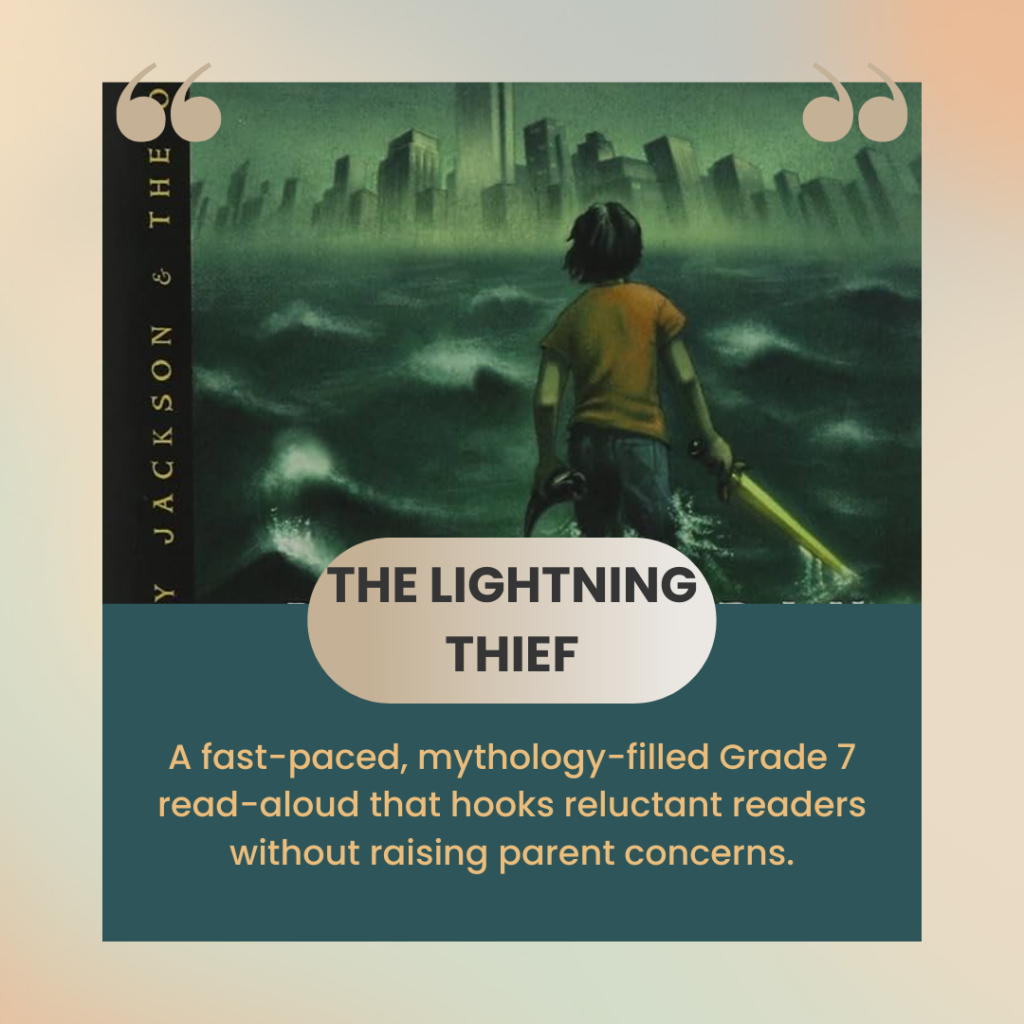
If you’re thinking about teaching The Lightning Thief in Grade 7, you’re probably asking:
-
Is Percy Jackson appropriate for middle school?
-
How violent is it?
-
Will parents object?
-
Is it still engaging in 2026?
Short answer?
Yes. It still works.
Long answer?
Let’s break it down so you walk in prepared.
Why The Lightning Thief Hooks Grade 7 Instantly
This book is engagement gold.
Within the first few chapters:
-
A teacher turns into a Fury.
-
Percy accidentally vaporizes her.
-
There’s a Minotaur attack.
-
His mother “dies.”
Middle schoolers are locked in immediately.
For reluctant readers — especially boys — this is often the first time they feel like a book moves at movie speed.
If you’ve read and reviewed:
👉 Seventh Son
👉 Artemis Fowl
👉 Magyk
you’ll notice The Lightning Thief sits in that same fantasy adventure lane — but with stronger humour and pacing.
Major Themes in The Lightning Thief
When teaching The Lightning Thief in Grade 7, prepare to discuss:
1️⃣ Identity & Belonging
Percy believes he is:
-
A problem student
-
ADHD
-
Dyslexic
-
“Not smart”
The twist?
Those traits are actually strengths.
This representation is powerful for middle schoolers.
It opens incredible conversations about:
-
Neurodiversity
-
Labels
-
Confidence
2️⃣ Family & Abandonment
Percy:
-
Never knew his father.
-
Thinks his dad doesn’t care.
-
Feels angry about it.
Later, we discover:
-
His father is Poseidon.
-
He was protected, not abandoned.
This theme resonates deeply in Grade 7/8.
3️⃣ Violence (Yes, There Is Quite a Bit)
Let’s address it honestly.
There are:
-
Sword fights
-
Monster battles
-
Characters stabbed or vaporized
-
Gods threatening violence
-
Medusa beheading (off-page but referenced)
However:
-
Violence is fantasy-based.
-
Deaths are rarely graphic.
-
Tone is adventurous, not traumatic.
Compared to:
👉 The Hunger Games
👉 The House of the Scorpion
this is significantly lighter.
Parent Risk Level
In most school communities, The Lightning Thief is considered very safe.
Common parent concerns (if any):
-
Mythology / Greek gods
-
Violence
-
Sword use
-
The portrayal of ADHD as a “battle reflex”
In conservative environments, mythology is occasionally questioned — but rarely challenged formally.
In my experience, this is far less controversial than:
👉 Dear Martin
👉 All American Boys
What Teachers Should Preview Before Reading Aloud
If you’re planning to read it aloud in Grade 7, reread:
-
The Minotaur scene (Percy’s mother “disintegrating”)
-
Medusa’s decapitation
-
The Ares fight
-
The Underworld confrontation
None are graphic — but emotional reactions can happen.
I would not skip these scenes.
They are central to plot and character growth.
But I would:
-
Pause for emotional processing.
-
Clarify fantasy vs. realism.
-
Remind students of mythological storytelling traditions.
Humor & Tone
One reason teaching The Lightning Thief in Grade 7 works so well is tone.
It’s funny.
Sarcastic.
Fast.
Students laugh out loud during read-aloud.
That alone makes it worth considering.
Best Way to Use It in Grade 7/8
✅ Read aloud for maximum engagement
✅ Pair with Greek mythology mini-lessons
✅ Use character analysis (Percy vs. Luke is powerful)
✅ Discuss loyalty and betrayal
✅ Compare to dystopian hero arcs
You could even build a comparison unit between:
Hero archetype vs. dystopian protagonist.
Is The Lightning Thief Appropriate for Middle School?
Yes.
It is:
-
Fast-paced
-
Emotionally manageable
-
Age-appropriate
-
Widely taught
-
Parent-safe in most communities
If you are looking for a high-engagement, low-controversy Grade 7 read-aloud — this is one of your safest bets.
Final Verdict
Engagement: ⭐⭐⭐⭐⭐
Parent Risk: ⭐⭐
Discussion Depth: ⭐⭐⭐⭐
Re-read Value: ⭐⭐⭐⭐⭐
If you’re trying to bring reluctant readers in — this book works.
If you’re trying to avoid controversy — this book works.
If you want something fun that still has depth — this book works.
Looking for more Fantasy Books?
If you’re teaching fantasy in middle school, also check out:
-
👉 Magyk