
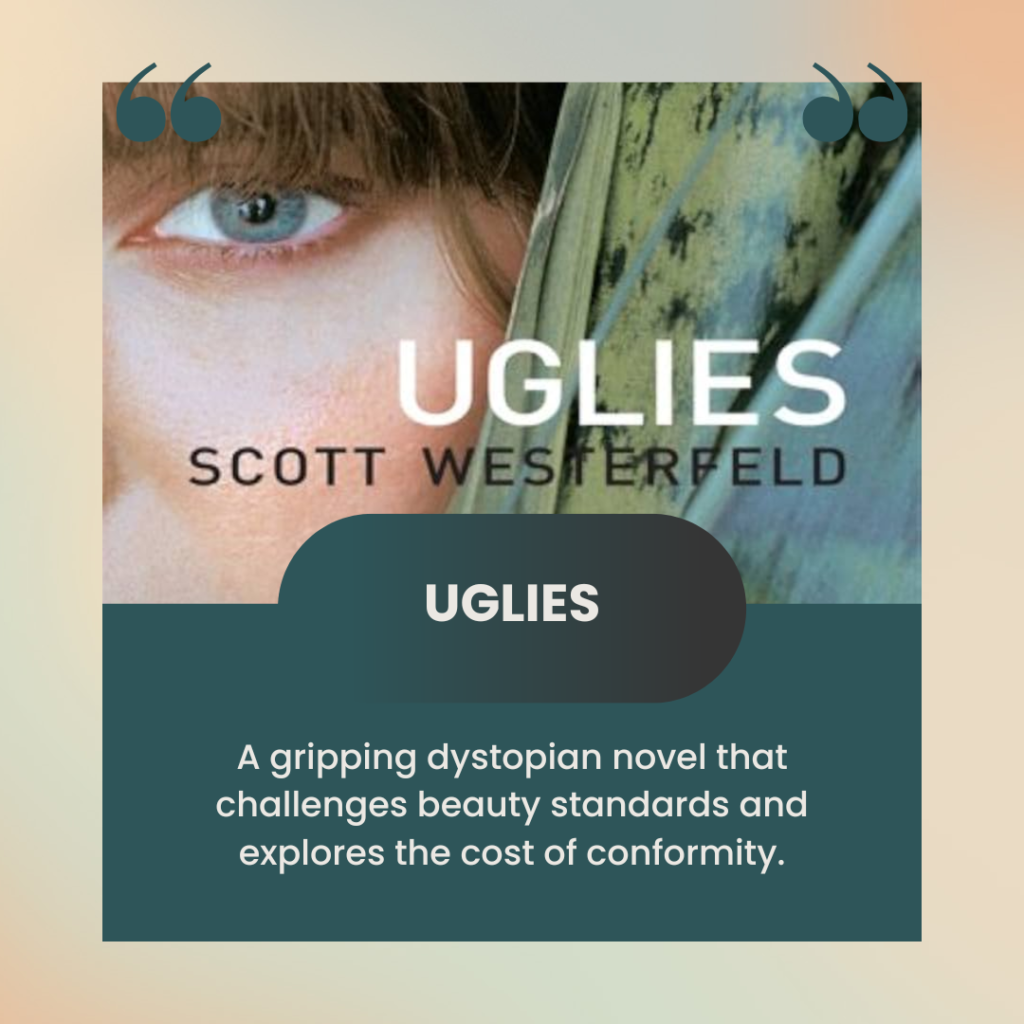
Teaching Uglies: Themes, Triggers & Grade 7/8 Teacher Prep

I read Uglies by Scott Westerfeld with a Grade 7 reading group, and I’ll admit that it took us a little while to get into it.

The beginning felt slow.

And when you’re reading something with middle school students, a slow beginning can be dangerous!

But then something clicked.

My students went from following along with our assigned reading to reading ahead because they wanted to know what happened next.

As a teacher, that’s about the best endorsement I can give a book.

Uglies is a dystopian novel built around an idea that Grade 7 and 8 students can immediately understand: What if everyone was considered ugly until they had surgery to become beautiful?

That premise opens the door to conversations about beauty standards, conformity, social media, body image, government control and what happens when a society decides there is only one acceptable way to look.

There are also some things teachers should know before choosing it, including cosmetic surgery, body image, romantic relationships, dangerous physical activities and some darker revelations about what the operation actually does.

So, spoilers ahead! Here’s what I think teachers should know before teaching Uglies in Grade 7 or 8.

What Is Uglies About?

Tally Youngblood lives in a future society where everyone is considered an “Ugly” until they turn sixteen.

Then they receive an operation.

The surgery changes their faces and bodies according to society’s standards of beauty, transforming them into “Pretties.”

Tally can’t wait.

Her best friend Peris has already turned sixteen and undergone the operation, leaving Tally behind in Uglyville while he enjoys his new life in New Pretty Town.

For Tally, becoming pretty doesn’t initially seem sinister.

It’s just what happens.

Then she meets Shay.

Shay doesn’t want the operation.

She questions why everyone needs to look a certain way and eventually runs away to a hidden community called the Smoke, where people have chosen to live outside the city’s control.

When authorities discover that Tally knows where Shay went, they give her an ultimatum:

Help them find the Smoke or Tally will never be made pretty.

Tally agrees.

And that’s when she begins discovering that becoming “pretty” involves much more than changing someone’s appearance.

Why Uglies Works So Well in Grade 7/8

Middle school is basically the perfect age for the central question of this book.

Grade 7 and 8 students are surrounded by messages about what they’re supposed to look like.

Hair.

Clothing.

Skin.

Weight.

Makeup.

Muscles.

Brands.

Filters.

Social media makes those messages even harder to escape.

Uglies takes that pressure and turns it into an entire society.

Everyone is told:

You aren’t attractive enough yet.

But don’t worry.

When you’re sixteen, we’ll fix you.

That’s creepy enough on its own.

What makes the book more interesting is that Tally initially believes it.

She’s not our rebellious protagonist standing outside the system and immediately recognizing that it’s wrong.

She desperately wants to become pretty.

That gives students a much more interesting character journey to examine.

Beauty Standards and Body Image

This is probably the most obvious theme in Uglies, but there is a lot to unpack.

Tally has been taught to see her natural appearance as defective.

Characters casually analyze physical features that society considers unattractive.

Technology can even show people what they might look like after becoming Pretty.

That could lead to some really interesting discussions about the beauty filters and editing tools students encounter today.

If technology can change a photograph of you to make your face supposedly “better,” what does that communicate about your actual face?

Who decides what beautiful means?

Why do beauty standards change?

And what happens when everyone is expected to meet the same standard?

At the same time, this theme is something I’d handle carefully.

Some Grade 7/8 students are already extremely self-conscious about their appearance.

I wouldn’t want a discussion about beauty standards to accidentally become an opportunity for students to analyze one another’s bodies or physical features.

Keep the conversation focused on systems, media and messages, not individual students.

Conformity and Individuality

This is where Uglies fits beautifully alongside The Giver and Divergent.

All three societies claim that conformity solves problems.

In Uglies, the argument is actually fairly compelling at first.

If everyone is equally beautiful, perhaps people will stop discriminating against one another based on appearance.

Nobody has to feel ugly.

Nobody gets advantages simply because they’re attractive.

Sounds great.

Except everyone has to undergo major surgery to accomplish it.

And eventually we learn that the surgery doesn’t only change people’s appearances.

It changes their brains.

That’s where the entire premise shifts.

The Pretty Operation Is Much More Disturbing Than It Initially Appears

This is one of the biggest spoilers teachers should know.

The operation creates lesions in people’s brains.

Those lesions make most Pretties more compliant, carefree and easier to control.

So the government isn’t simply creating a society where everyone looks beautiful.

It’s altering people’s ability to question that society.

That completely changes the ethical question.

People technically choose the operation.

But can we call it informed consent when they’ve been conditioned their entire lives to believe they are ugly without it — and nobody tells them their brains will also be altered?

That’s a fantastic Grade 7/8 discussion.

Government Control

The Special Circumstances organization becomes increasingly important as Tally discovers what is actually happening.

Dr. Cable manipulates Tally into betraying the Smoke.

Tally is given a tracking device and sent to locate Shay and the others.

What I find interesting here is that the government doesn’t need to control everyone through obvious violence.

Most people want what the government is offering.

They want to become Pretty.

They want the parties.

They want New Pretty Town.

They don’t realize what they’re giving up.

That makes Uglies an excellent comparison with other dystopian novels because the control is packaged as something desirable.

Friendship and Betrayal

Tally’s relationship with Shay gets complicated.

Very complicated.

Tally initially follows Shay to the Smoke because Special Circumstances forces her to.

She intends to activate the tracker.

Then she begins questioning everything she believed about the Pretty operation.

Unfortunately, the tracker still leads Special Circumstances to the Smoke.

From Shay’s perspective, Tally betrayed her.

And honestly?

She did.

Even if Tally changes her mind, her decisions have consequences.

That’s something I appreciate about the book.

Tally isn’t perfect.

Students can debate whether she deserves forgiveness and whether being manipulated excuses what she did.

Romance in Uglies

There is a romantic storyline involving Tally and David.

David has grown up outside the city and sees Tally differently than she sees herself.

Their relationship includes attraction and kissing, but I wouldn’t consider the romance particularly concerning for Grade 7/8.

It’s also connected directly to the book’s discussion of appearance.

Tally has spent her entire life believing she needs surgery to become beautiful.

David is attracted to her before that transformation.

That challenges something Tally has believed about herself for her entire life.

There is also tension involving Shay’s feelings for David, which complicates Tally and Shay’s friendship.

Violence and Dangerous Situations

Uglies contains action and danger, although I would generally consider it less violent than The Hunger Games, The Maze Runner or Divergent.

Characters engage in dangerous hoverboarding and travel through potentially hazardous environments.

Special Circumstances raids the Smoke.

People are captured and restrained.

There are confrontations and injuries.

David’s father, Az, also dies after being subjected to an experimental procedure by Special Circumstances.

That death is important because it makes the consequences of the government’s actions much more concrete.

This isn’t simply a philosophical disagreement about beauty anymore.

People are being harmed.

Medical Procedures and Bodily Autonomy

If I were teaching Uglies today, I’d probably spend more time on this than I would have when I originally read it.

The entire society is built around mandatory or heavily coerced medical alteration.

The characters are teenagers.

They have been raised from childhood believing the operation is necessary.

That gives you some fascinating questions about bodily autonomy and consent.

Can someone meaningfully consent to a procedure when they’ve been taught their entire life that refusing it will make them socially unacceptable?

Does society have the right to alter someone’s body for what it claims is the greater good?

What information does someone need before they can give informed consent?

Those are sophisticated questions, but Grade 7/8 students can absolutely begin engaging with them.

Is Uglies Appropriate for Grade 7?

Based on my own experience?

Yes, for many Grade 7 students.

I actually used it with a Grade 7 reading group.

The biggest issue we had wasn’t mature content.

It was getting through the slower beginning.

Once the story picked up, though, my students became invested enough that they started reading ahead.

In terms of teacher concerns, I’d be aware of:

  • Body image and beauty standards
  • Cosmetic surgery
  • Medical experimentation
  • Brain alteration
  • Death
  • Government manipulation
  • Dangerous physical situations
  • Romantic relationships
  • Betrayal

Compared with some other popular dystopian YA novels, however, Uglies is relatively manageable.

There isn’t the same level of child-on-child violence as The Hunger Games.

It doesn’t have the suicide and sexual-threat content teachers need to consider in Divergent.

And while there is danger, it doesn’t lean as heavily into horror imagery as The Maze Runner.

That makes it one of the dystopian books I’d feel more comfortable considering for Grade 7.

Read-Aloud, Literature Circles or Classroom Library?

Literature Circles

This is where I have actually used it, and it worked.

The slower opening might require a little encouragement, but once my students got into the story, they wanted to keep going.

I’d absolutely use it this way again.

Classroom Library

Definitely.

Especially for students who have already enjoyed The Hunger Games, Divergent or The Maze Runner.

It’s also the beginning of a series, so students who become invested have somewhere to go next.

Read-Aloud

I think it could work, although it wouldn’t necessarily be my first choice.

Because the opening takes some time to establish the world, you may have to sell students on the premise initially.

For a read-aloud, The Maze Runner hooks students with immediate danger.

Uglies asks them to wait a little longer.

The payoff is there.

You just might have to help them reach it.

Uglies Is PERFECT for a Dystopian Literature Circle Unit

At this point, I think this is one of the strongest reasons to keep Uglies in your Grade 7/8 toolbox.

Imagine students reading different dystopian novels:

Then bring everyone back together and ask:

How does each society control its citizens?

The answers are completely different.

Sameness.

Beauty.

Fear.

Identity.

Entertainment.

Power.

But underneath all of them is essentially the same question:

How much freedom should individuals sacrifice for a society that promises to make their lives better?

That’s a much richer culminating task than six groups simply presenting summaries of their books.

Final Verdict

I originally gave Uglies 4/5 stars, and I’d keep that rating.

It isn’t perfect.

The beginning can be slow, and I saw that firsthand when reading it with Grade 7 students.

But I also saw those same students eventually get hooked enough that they started reading ahead.

That’s why I’d still recommend it.

There is plenty here for students who simply want an interesting dystopian adventure, but teachers can dig much deeper into beauty standards, body image, conformity, government control, informed consent and identity.

And years after its original publication, I actually think its central premise may be more relevant to middle school students now.

They live in a world of filters, photo editing, influencers and algorithms constantly showing them what they’re supposedly meant to look like.

Uglies takes that idea to an extreme.

But maybe not quite as extreme as it once seemed.

Overall: 4/5 stars ⭐⭐⭐⭐

Until next time,

Margaret