
Teaching Posted by John David Anderson: Grade 6–8 Teacher Prep
I read Posted by John David Anderson with a class a few years ago, right around the time Ontario schools were cracking down on cellphone use in classrooms.
Honestly, the timing could not have been better.
The whole premise felt incredibly current to my students because they knew exactly what it was like to have phones as part of school life. They understood how quickly messages spread, how much social drama could happen through a screen, and how weird it felt to imagine a school where phones were suddenly taken out of the equation.
That may actually become one of the interesting challenges with teaching Posted in the future.
As cellphone restrictions become more normal, younger students may eventually have less personal experience with what it was like when phones were constantly present in class. The basic premise may start to feel more historical than current.
But even beyond the cellphone connection, my students were hooked.
The twists and turns kept them completely invested, and they were genuinely upset whenever my student teacher—who was reading it aloud to them in roughly 20-minute chunks each day—was away or we missed our reading time.
That alone tells me a lot about how well this book works as a middle school read-aloud.
As always, spoilers ahead. If you’re thinking about teaching Posted, here’s what I think teachers should know first.
What Is Posted About?
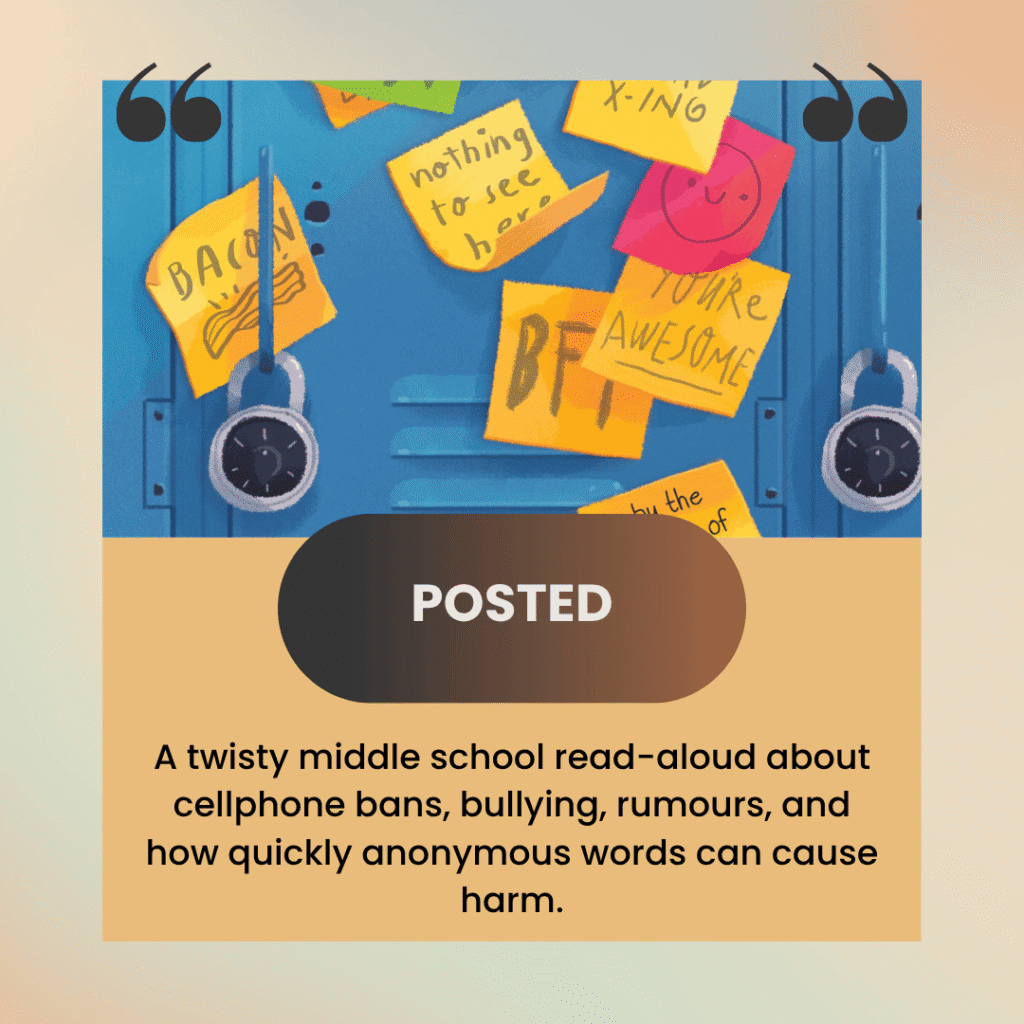
Posted takes place at Branton Middle School, where cellphones are banned after an incident involving students and social media.
Without phones, students start communicating in a much more old-fashioned way:
sticky notes.
At first, the notes seem funny and harmless.
Then they start becoming more personal.
More anonymous.
More cruel.
And eventually, they begin changing the entire social atmosphere of the school.
What starts as a story about a cellphone ban quickly becomes a story about bullying, rumours, social power, friendship, exclusion, and what happens when people can say hurtful things without having to face the person they are hurting.
That is where the book becomes much more interesting than its premise suggests.
Why My Students Loved It
My class really enjoyed this one.
The book has enough mystery and unpredictability to keep students guessing, and the daily read-aloud format worked incredibly well.
We were reading in roughly 20-minute increments, and my students absolutely noticed when we missed a day.
If my student teacher was away or we didn’t get to the read-aloud, they were frustrated because they wanted to know what happened next.
That is exactly what I want from a whole-class novel.
I don’t want students politely tolerating a story because the teacher picked it.
I want:
“Are we reading today?”
That was Posted.
The Cellphone Ban Was Incredibly Timely
When we read the book, Ontario schools were dealing with new restrictions around cellphone use in classrooms.
That made the premise immediately relevant.
My students understood what it meant to have a phone in class.
They understood checking messages.
They understood group chats.
They understood how quickly something posted online could spread.
So when the phones disappeared in Posted, they could immediately imagine the social vacuum that created.
What I find interesting now is that this part of the book may slowly change for future students.
If cellphone restrictions become a normal part of school from the time students are young, they may eventually have much less experience with unrestricted phone access during class.
That doesn’t make the novel irrelevant.
It just changes the conversation.
Instead of asking:
“What would happen if your phones were suddenly banned?”
teachers may eventually ask:
“Why do you think banning phones felt like such a big deal to students at the time?”
That is a very different question.
But Posted Is Not Really About Phones
The more important thing is that the book still works even if the cellphone premise becomes less relatable.
Because Posted is really about communication.
Take away phones and students still find ways to communicate.
They still gossip.
They still form groups.
They still exclude people.
They still say things they would never say directly to someone’s face.
The technology changes.
The behaviour doesn’t necessarily change with it.
That makes the novel much more durable than a simple “phones are bad” story.
Anonymous Notes Change Everything
One of the strongest ideas in the book is what happens when students can communicate anonymously.
A sticky note seems small.
Easy to ignore.
Easy to throw away.
But once anonymous messages start circulating, the school becomes more tense.
Students don’t always know who wrote something.
They don’t know who has seen it.
They don’t know whether a comment was meant as a joke or an attack.
And because the author can remain hidden, people become willing to say things they might never say face-to-face.
That creates some really good conversations about online behaviour even though the actual messages are written on paper.
Is Something Less Harmful Because It Is Written?
This is one question I would absolutely ask students.
A cruel note can be physically tiny.
But that doesn’t mean the impact is tiny.
Students sometimes understand spoken bullying as “real” while treating written comments, memes, posts, or anonymous messages as less serious.
Posted challenges that.
Words still have consequences.
And sometimes written words are actually worse because they can be passed around, reread, photographed, shared, and remembered long after the person who wrote them has moved on.
Bullying and Social Exclusion
Bullying becomes one of the book’s biggest themes.
And like most good middle school books, it isn’t simply:
Here is the bully. Here is the victim.
Students make complicated choices.
Some participate.
Some laugh.
Some stay quiet.
Some try to help.
Some don’t realize how much damage is being done until things have already gone too far.
That gives teachers a lot more to work with than simply identifying who behaved badly.
For another middle school book that looks closely at bullying, accountability, and whether someone can change after causing harm, I’ve also reviewed Restart by Gordon Korman.
Bystanders Matter
One thing I would focus on if I taught Posted again is the role of the bystander.
Students often know what a bully is.
They know what a victim is.
The more difficult role is the student who:
sees something,
knows it is wrong,
but does nothing.
Why?
Fear?
Wanting to fit in?
Not wanting attention?
Thinking it isn’t serious enough?
Not knowing what to do?
Those are much richer conversations.
For another novel where students have to think carefully about how bystanders respond when something hateful happens in their community, Linked by Gordon Korman would be a really strong companion text.
The Cruelty Escalates
One of the things teachers should know is that the notes become increasingly hostile.
The social conflict does not stay playful.
Messages become personal and hateful, and the atmosphere at the school becomes increasingly uncomfortable.
There are also moments where symbols and language carry a much larger meaning than the students using them may initially understand.
That is something I would absolutely preview before reading the novel aloud.
If you have students with personal experiences of bullying, hate speech, racism, antisemitism, or social exclusion, some of those scenes may land much more heavily than others.
Hate Symbols and Historical Meaning
One of the reasons Posted connects so naturally with Linked is the way students encounter harmful symbols or messages inside a modern school environment.
That creates an important teaching opportunity.
Students may see a symbol and treat it as:
a joke,
graffiti,
a prank,
or something “edgy.”
But symbols can carry historical weight that students may not fully understand.
That doesn’t excuse using them.
It means teachers may need to stop and provide context.
If you’re looking for another middle school novel that deals directly with antisemitism, hate symbols, and the responsibility young people have when hateful behaviour appears in their community, Linked is an especially natural next read.
Friendship Is Under Pressure Too
The book isn’t only about school-wide bullying.
It is also about friendship.
As the note war escalates, students begin questioning who they can trust.
Friend groups shift.
People take sides.
Some students discover things about one another that they did not expect.
That makes Posted a useful book for talking about how social pressure affects relationships.
Middle school friendships can feel incredibly intense.
Sometimes one disagreement can suddenly feel like the end of the world.
The novel understands that.
Social Power and Popularity
Another interesting classroom angle is the way social power operates when the normal communication system disappears.
Who gets listened to?
Who controls the narrative?
Who becomes a target?
Who has enough social influence to make a rumour spread?
Those questions still matter whether students are communicating through sticky notes, group chats, social media, or whatever comes next.
That is another reason I think the book can remain relevant even as technology changes.
Would Posted Still Work With Students Today?
I think so.
But probably in a slightly different way.
When my class read it, the cellphone ban felt extremely current.
Students could immediately compare the fictional school to what was happening around them.
Future students may not have that same connection.
But they will still understand:
- rumours
- anonymous messages
- exclusion
- screenshots
- private group chats
- bullying
- public embarrassment
- social status
- saying things online that someone would never say in person
The platform may change.
The social behaviour probably won’t.
What Teachers Should Know Before Using Posted
Compared with many of the heavier Grade 7/8 books I review, Posted is relatively manageable in terms of violence and mature content.
The bigger concerns are social and emotional.
Teachers should be prepared for:
- Bullying
- Anonymous harassment
- Cruel written messages
- Social exclusion
- Rumours
- Friendship conflict
- Hate speech or hateful symbols
- Students using historical symbols without fully understanding their meaning
- Escalating school conflict
- Public humiliation
- Emotional distress
For students who have recently experienced bullying or social exclusion, some of this may feel very close to home.
Is Posted Appropriate for Grade 6?
Yes.
I think Grades 6–8 are a very natural fit.
The school setting is immediately familiar.
The conflicts are understandable.
The mystery and twists keep the story moving.
And the themes are substantial without being overwhelmingly mature.
For Grade 6, I would probably prefer it as a teacher-supported read-aloud.
Grade 7 or 8 students could handle it in a book club or literature circle as well, although I still think the whole-class discussion is one of the book’s biggest strengths.
Why I Think It Works Best as a Read-Aloud
This is probably my favourite use for Posted.
I know it works because I watched it happen.
My students were invested.
They wanted the next section.
They complained when we missed reading time.
That kind of anticipation is difficult to manufacture.
The twists also lend themselves perfectly to stopping points.
You can read for twenty minutes, stop at a reveal, and immediately have students begging you to continue.
That makes it especially useful for a daily read-aloud routine.
Literature Circles or Book Clubs
I could also see Posted working in a small group, especially if your theme is:
- Bullying
- Communication
- Friendship
- Social media
- Identity
- Bystanders
- School culture
But if I had enough copies and the right group, I would still lean toward a class read.
A lot of the value comes from everyone discussing how the school environment changes together.
Classroom Library
Yes.
I would keep it on the shelf.
The pacing is strong enough for independent readers, and the premise is easy to explain to a student looking for something realistic but still suspenseful.
It also gives you an easy next recommendation for students who liked books such as Restart or Wonder because of the school-based social conflicts.
Posted and Wonder
These books are very different, but they connect well around bullying and how entire peer groups can contribute to making someone feel excluded.
Wonder asks students to think about visible difference, empathy, and what happens when a child becomes socially isolated.
Posted focuses more on communication, rumours, anonymity, and the way cruelty spreads through a school.
Reading them together could create an interesting discussion about whether bullying looks different depending on the method.
Posted and Bifocal
I would also consider Bifocal as a related text for older middle school readers.
Both books examine what happens when tension spreads through a school community and students begin reacting based on fear, rumours, stereotypes, or social pressure.
The content is different, but the underlying question is similar:
How does a school community change when people stop trusting one another?
Suggested Discussion Questions for Posted
I would definitely use discussion questions with this one because the book gives students so many opportunities to connect the story to their own school experiences.
- Why does banning phones change the social environment at Branton Middle School?
- Do you think the phone ban actually solves the original problem?
- Why do students immediately find another way to communicate?
- Why does anonymity make some people more willing to be cruel?
- Is a written insult less harmful than something said aloud?
- Why do rumours spread so quickly?
- What responsibility does someone have if they receive a cruel note but did not write it?
- What should a bystander realistically do?
- Why do students sometimes participate in bullying even when they know it is wrong?
- When does a joke become bullying?
- How does the note war affect friendships?
- How does social status influence which messages people believe?
- Would the story work differently if it took place today?
- If students are used to cellphone restrictions, what modern form of communication could replace the sticky notes?
- Does removing technology fix harmful behaviour, or does the behaviour simply move somewhere else?
- Why do symbols sometimes carry meanings that are much bigger than the person using them realizes?
- What could the adults in the school have done differently?
- At what point does the situation become bigger than a conflict between individual students?
I especially like that second-last question about technology because it keeps the book relevant even as school cellphone culture changes.
Final Thoughts
My class really liked Posted.
And honestly, the strongest evidence I can give is that they were upset when they didn’t get their daily twenty minutes.
They wanted to know what happened next.
The timing also made the book especially memorable for us because we were reading it right around the time cellphone restrictions were becoming a major conversation in Ontario classrooms.
That specific connection may become less immediate for future students.
But I don’t think the book’s bigger themes are going anywhere.
Technology changes.
Rumours don’t.
Bullying doesn’t.
Social exclusion doesn’t.
The temptation to say something anonymously that you would never say face-to-face probably isn’t disappearing either.
That’s why I still think Posted has a lot of classroom value.
For me, it works best as a Grade 6–8 read-aloud, especially if you want a novel that can open conversations about bullying, communication, bystanders, rumours, and school culture while still giving students enough twists and turns to keep them invested.
And if your students are anything like mine, you may find yourself in trouble if you skip a reading day.
Overall: 4.5/5 stars ⭐⭐⭐⭐½
Until next time,
Margaret