
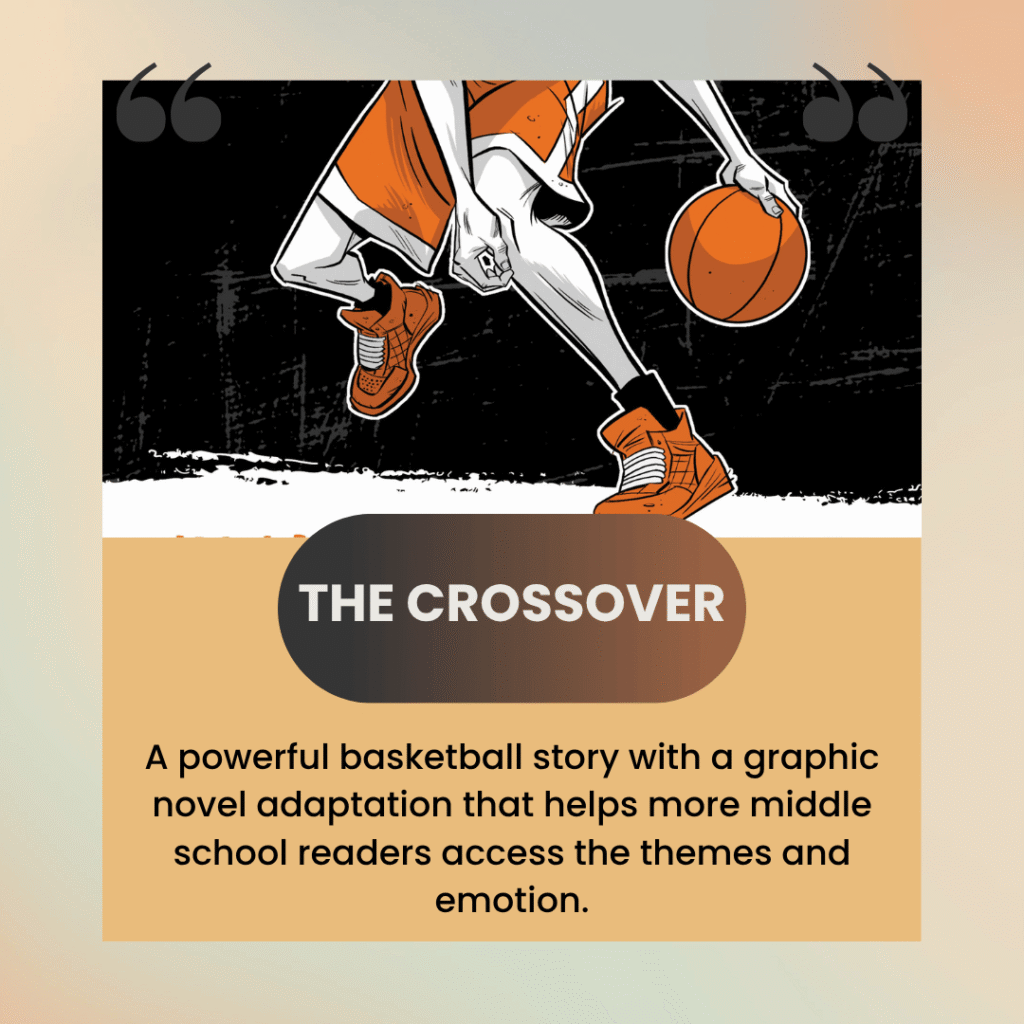
I’ve had really good luck with The Crossover by Kwame Alexander in the classroom.
Sports books are often one of my easiest ways into reading with students who insist they don’t like books, and basketball gave this one an immediate hook.
But what made The Crossover especially useful for me was the fact that the story is available in more than one format.
Some of my students loved the original novel in verse.
Others connected much more easily with the graphic novel adaptation.
For my low-interest readers and ESL students who were still developing their English vocabulary, having that visual support made a huge difference. They could access the same characters, family story, themes and emotional moments without being overwhelmed by a traditional novel.
And there is a lot more going on in The Crossover than basketball.
This is ultimately a story about brotherhood, jealousy, growing up, family relationships, health, grief and loss.
So, as always, spoilers ahead. Here’s what I think teachers should know before using The Crossover in Grades 6–8.
What Is The Crossover About?
Josh Bell and his twin brother Jordan are talented basketball players.
Basketball is a huge part of their family.
Their father, Chuck Bell, was a professional basketball player, and the boys have grown up surrounded by his advice, stories and love of the game.
At the beginning of the novel, Josh and Jordan are extremely close.
Then things start changing.
Jordan begins spending more time with a girl.
Josh feels left behind.
Their relationship becomes increasingly strained.
At the same time, their father’s health becomes a growing concern.
The book follows the twins both on and off the basketball court as they deal with jealousy, conflict, family expectations and eventually a devastating loss.
The story is told in verse, which gives it a completely different rhythm from a traditional middle-grade novel. The structure itself becomes part of the experience.
Why The Crossover Works for Reluctant Readers
This is one of the biggest reasons I recommend it.
The pages don’t look intimidating.
The verse format creates plenty of white space.
The sections move quickly.
And basketball keeps the story moving.
For students who look at a dense page of text and immediately decide a book is “too much,” The Crossover can feel much more approachable.
That matters.
Sometimes the hardest part of getting a reluctant reader engaged is simply getting them to believe they can finish the book.
And The Crossover gives them a much better chance of feeling successful.
The Verse Format Is Part of the Story
I wouldn’t treat the poetry as something students have to “get through” in order to reach the plot.
It’s part of what makes the book work.
The rhythm of the language often mirrors basketball.
Some poems move quickly.
Some slow things down.
The layout changes.
Words are emphasized.
The pacing can feel almost like watching a game.
That gives teachers a nice opportunity to talk about how form affects meaning.
Why did Kwame Alexander choose verse?
What would change if this were written as a traditional novel?
How does the spacing or rhythm affect the way a scene feels?
Those are much more interesting questions than simply asking students to identify poetic devices.
Brotherhood and Jealousy
The relationship between Josh and Jordan is probably the emotional centre of the book.
They begin as incredibly close twins.
But when Jordan starts dating, Josh feels like he is losing his brother.
That jealousy begins affecting how Josh behaves.
He becomes frustrated.
He lashes out.
And eventually, during a basketball game, he throws the ball hard enough to injure Jordan.
That moment matters because Josh’s anger has consequences.
It isn’t just sibling irritation anymore.
Students can explore some really useful questions here:
When does jealousy become harmful?
Can you understand why someone is angry without excusing what they do?
How do relationships change as people grow up?
Those are very middle-school questions.
Accountability and Consequences
This is another reason the book works well in Grades 6–8.
Josh makes a serious mistake.
He hurts his brother.
He has to live with the consequences.
That creates room for the same kind of conversations I like having around books such as Restart.
What does accountability actually look like?
Is saying sorry enough?
What happens when you do something you immediately regret?
Can a relationship recover after someone has caused harm?
Those questions move the book far beyond basketball.
Family Expectations
The Bell family is close, but there are also expectations tied to basketball, masculinity and success.
Chuck is proud of his sons.
He wants them to succeed.
He has his own identity tied closely to basketball.
That gives students something interesting to think about:
What happens when a parent’s past becomes part of a child’s expectations?
How much of Josh and Jordan’s identity comes from what they want?
And how much comes from the family story they were born into?
Dad’s Health Problems
This is the biggest content issue teachers should know about.
Chuck’s health declines over the course of the novel.
He has high blood pressure and other warning signs, but he does not always take those concerns seriously.
Eventually, his condition becomes much more serious.
The official educator material describes his declining health as an important part of the story, and it ultimately leads to the novel’s emotional climax.
This is one of those plotlines that can hit students very differently depending on their own family experiences.
Death and Grief
Chuck eventually dies.
That is the biggest emotional moment in the novel and one teachers should absolutely know is coming.
The loss affects the entire family, but especially Josh and Jordan.
For students who have lost a parent, grandparent or other close family member, this part of the book may feel very personal.
I wouldn’t avoid the book because of it.
But I also wouldn’t want to be surprised by it halfway through a read-aloud.
This is definitely a know your students situation.
Basketball as a Metaphor
One of the things I like about The Crossover is that basketball isn’t just there to attract sports readers.
The game becomes a way of thinking about life.
Timing matters.
Teamwork matters.
Knowing when to pass matters.
Knowing when to take the shot matters.
Mistakes matter.
And sometimes you have to adjust quickly because the situation changes.
That makes the sports elements useful even for students who aren’t huge basketball fans.
For another competition-centred book where the sport or game becomes a vehicle for something much deeper, Grandmaster is also worth checking out.
The Graphic Novel Adaptation Was Especially Useful
This is probably the part I’d emphasize most strongly from my own classroom experience.
I had students who enjoyed the original novel.
But I also had students who were much more successful with the graphic novel adaptation.
That visual support mattered.
For some of my ESL students, especially those still developing English vocabulary, a page of verse could still contain unfamiliar language even if it wasn’t visually dense.
The graphic novel gave them more context.
Facial expressions.
Settings.
Movement.
Visual clues.
All of those things helped students infer meaning without stopping constantly to decode every unfamiliar word.
The same was true for some low-interest readers.
They were still reading the same basic story and discussing the same themes.
They just had a format that better supported them.
That’s not “making the work easier.”
That’s making the text more accessible.
And I think that distinction matters.
Original Novel vs. Graphic Novel
I wouldn’t necessarily require every student to read the same version.
If the goal is to discuss:
- Character development
- Brotherhood
- Jealousy
- Grief
- Family
- Accountability
- Theme
then students may be able to reach those goals through either format.
You could even make the format choice part of the learning.
Students could compare a scene in the verse novel with the same scene in the graphic novel.
What does the illustrator add?
What does the reader imagine in the original version?
Does the graphic adaptation change the emotional impact?
What gets lost?
What becomes clearer?
That gives you a built-in media-literacy activity without requiring a completely separate text.
What Teachers Should Know Before Using The Crossover
Compared with many middle-school books I’ve reviewed, the mature content here is relatively manageable.
The biggest things I’d want teachers to know about are:
- Death of a parent
- Grief
- Illness and declining health
- Sibling conflict
- Jealousy
- Physical injury
- Anger
- Romantic interest/dating
- Family tension
The emotional content is much more significant than anything graphic or explicit.
That makes this a book I’d feel fairly comfortable recommending across Grades 6–8.
Is The Crossover Appropriate for Grade 6?
Yes.
I think Grade 6 is actually one of the strongest fits.
The sports hook is accessible.
The verse structure is manageable.
The characters are relatable.
And the themes are substantial without feeling overwhelmingly mature.
It also works well into Grades 7 and 8, particularly for students who need a high-interest book that doesn’t look intimidating.
Classroom Library, Literature Circles or Read-Aloud?
Classroom Library
Absolutely.
This is probably where I’d start.
It’s the kind of book I can hand to a student who tells me they like basketball and immediately have a reasonable chance of getting a yes.
Literature Circles
Also a strong option.
I especially like it for a mixed-format literature circle where some students use the original novel and others use the graphic adaptation.
Everyone can still participate in the same discussion.
Read-Aloud
Yes.
The verse format actually lends itself really well to being read aloud because the rhythm is such a big part of the book.
The author’s educator guide also specifically encourages reading or listening to the novel and discussing how the characters develop across its sections.
For the right group, this could be a really engaging whole-class choice.
A Great Choice for ESL and Developing Readers
I want to emphasize this because it’s one of the biggest reasons the book worked for me.
A student being capable of discussing big ideas does not automatically mean they have the English vocabulary to access every traditional novel independently.
Those are different skills.
The graphic novel adaptation gave some of my ESL students enough scaffolding to participate meaningfully in conversations about family, jealousy, grief and character choices.
That meant they weren’t stuck with a much younger story simply because their English language development was still catching up.
That’s important.
Middle school students deserve books that respect their age and interests while still being accessible.
If Your Students Like The Crossover
This is where I’d build your sports-reader pathway.
A student who enjoys The Crossover might also enjoy:
- Fast Break for another basketball-centred story involving family, belonging and trust
- Booked for another Kwame Alexander sports story, this time centred around soccer
- Grandmaster for competition mixed with complicated family relationships and emotional themes
And if what they responded to most was the emotional side rather than the sport, I might also point them toward Restart or Ghost Boys depending on the reader.
That gives you several really natural internal links once this post is live.
Final Thoughts
The Crossover works because it gives students an easy way in.
Basketball gets some students interested.
The verse structure makes the book feel manageable.
The graphic novel adaptation gives even more students a way to access the story.
But once they’re in, they’re reading about much bigger things.
Brotherhood.
Jealousy.
Family.
Growing up.
Health.
Death.
Grief.
And learning what happens when the people you love start changing — or when life changes before you’re ready.
That combination is why I think this is such a useful middle school book.
And based on my own students’ reactions, I’d absolutely keep both the original and graphic novel versions available.
Sometimes accessibility isn’t about finding an easier story.
It’s about finding the right version of a strong story for the student standing in front of you.
Overall: 5/5 stars ⭐⭐⭐⭐⭐
Until next time,
Margaret