
Teaching Swing by Kwame Alexander: Grade 7–8 Teacher Prep
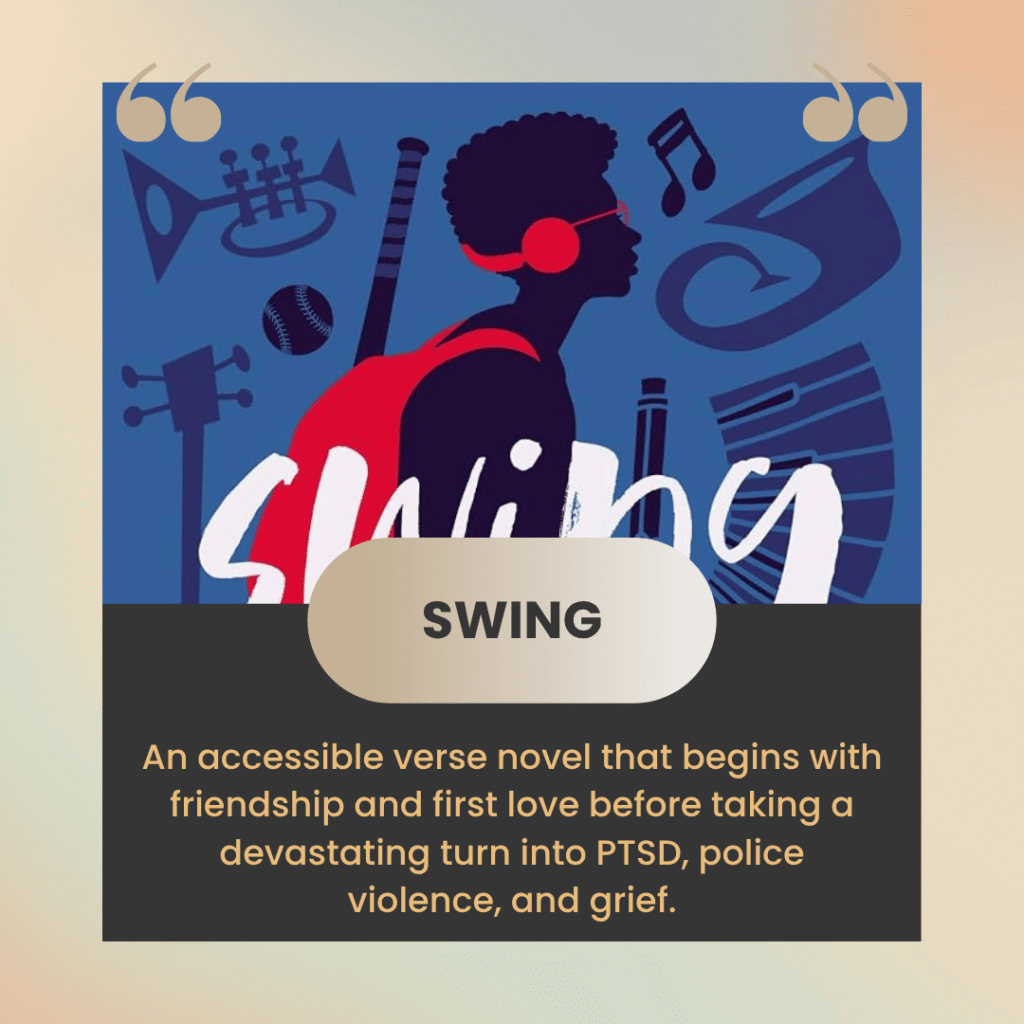
Swing by Kwame Alexander and Mary Rand Hess was not quite the book I expected.
For most of the novel, we’re following two teenage boys navigating friendship, baseball, romance, and all the awkwardness that comes with growing up.
There’s an unspoken crush, a first kiss, questions about relationships, and a whole lot of jazz.
It’s charming, funny, and surprisingly innocent in places.
But something much darker is developing in the background.
As the story progresses, the seemingly unrelated events happening around the community begin to come together. What starts as an ordinary teenage coming-of-age story eventually explores military trauma, PTSD, racial profiling, police violence, and devastating loss.
Like Alexander’s other novels, Swing is written in verse. That makes it particularly interesting for students who might be intimidated by a traditional novel.
I’ve previously discussed The Crossover and Booked, two other Kwame Alexander books that offer accessible reading experiences for middle school students. Swing has some of those same advantages, but its subject matter requires more consideration.
This is not simply a lighthearted sports novel.
So, as always, spoilers ahead! Here’s what teachers should know before introducing Swing to students.
What Is Swing About?
Seventeen-year-old Noah and his best friend Walt, nicknamed Swing, have been trying unsuccessfully to make their high school baseball team.
Noah is beginning to accept that baseball might not be in his future.
Walt refuses to give up.
He’s enthusiastic, determined, and convinced that their lives are about to improve. He’s also obsessed with jazz, especially the music of artists such as John Coltrane.
Meanwhile, Noah has been in love with his childhood friend Sam for years.
Unfortunately, Sam doesn’t see him the same way.
When Noah discovers a collection of old love letters in a bag purchased at a thrift store, he begins using their words to create artwork expressing his feelings for her.
Walt encourages him to take a chance.
As Noah struggles with romance and self-confidence, something strange is happening around their community.
American flags are appearing in unexpected places.
Nobody seems entirely certain who is responsible or what the flags mean.
Some residents interpret them as patriotic.
Others see something much more threatening.
Meanwhile, Walt’s older brother, Moses (Mo), has returned home from military service in Afghanistan.
Although Walt is thrilled to have his brother home, there are signs that Mo is struggling. His experiences overseas have left him dealing with significant psychological trauma, and the people around him don’t always understand what he’s experiencing.
As the mystery surrounding the flags develops, these seemingly separate storylines begin coming together.
The novel’s relatively lighthearted beginning makes the ending particularly devastating.
Friendship Is the Heart of the Story
Although Noah narrates the novel, Walt is arguably its most memorable character.
He’s energetic, optimistic, and constantly encouraging Noah to take chances.
Walt believes in making the most of life.
He wants to make the baseball team.
He wants to find love.
He wants Noah to stop sitting on the sidelines.
And he believes that setbacks are simply opportunities to try again.
Their friendship creates much of the humour and warmth in the novel.
I think this relationship would provide some excellent discussion opportunities for Grade 7 and 8 students.
Walt is certainly supportive, but he also crosses boundaries.
When he shares Noah’s private writing with Sam, he genuinely believes he’s helping.
But good intentions don’t automatically make someone’s actions acceptable.
That’s a useful conversation to have with middle school students.
What responsibilities do friends have toward one another?
When does encouragement become interference?
Is it acceptable to make a decision for someone because you think you know what’s best?
These are questions students can explore before moving into the heavier themes of the novel.
For another Kwame Alexander novel that examines how relationships change as teenagers grow up, The Crossover offers similar opportunities through the complicated relationship between twin brothers Josh and Jordan.
Baseball, Jazz, and Finding Your Voice
One of the interesting things about Swing is how music and baseball work together throughout the story.
Walt loves jazz.
He admires musicians who improvise, experiment, and develop their own distinctive styles.
He wants Noah to approach life with that same willingness to take chances.
Baseball becomes another metaphor for this idea.
You cannot succeed without stepping up to the plate.
You might miss.
You might strike out.
But you have to try.
That message is repeated throughout the novel, particularly through Walt’s determination to make the baseball team despite repeated disappointments.
The jazz references also give music teachers an interesting opportunity to explore how musical improvisation connects to personal expression.
A jazz musician develops a unique voice through experimentation.
Noah begins developing his own voice through poetry and artwork.
Walt encourages both of them to stop worrying so much about failure.
For a cross-curricular activity, students could explore how the structure of Alexander’s poetry resembles musical phrasing.
Why do some poems feel quick and energetic?
Why do others slow down?
How does the spacing of words influence the rhythm?
The official Swing educator’s guide provides additional activities connected to the novel’s themes and literary structure.
The Mystery of the American Flags
Throughout the novel, American flags begin appearing around the community.
Initially, this seems like a strange background mystery.
It gradually becomes much more important.
Different characters interpret the flags in different ways.
For some, the American flag represents patriotism, pride, and national unity.
For others, the sudden appearance of flags feels threatening, particularly when viewed through their experiences of racism and exclusion.
This could make an excellent critical-thinking activity.
Ask students whether a symbol can mean different things to different people.
Can something intended as patriotic feel threatening to someone else?
Does the meaning of a symbol depend on who is displaying it?
What role does historical context play?
Students could also explore how assumptions influence the way characters interpret the mystery.
The discussion could connect to my review of Linked by Gordon Korman, which similarly raises questions about public symbols, historical prejudice, and the way communities respond to unsettling events.
PTSD and the Challenges of Returning Home from War
One of the most significant elements of Swing is the portrayal of Walt’s older brother, Mo.
Mo has recently returned from serving in Afghanistan, but coming home doesn’t mean that his experiences overseas are behind him.
Throughout the novel, there are indications that he’s struggling.
He seems disconnected from the people around him, and his behaviour suggests that his time overseas has left him dealing with serious psychological trauma.
Walt, however, is excited to have his brother home and struggles to acknowledge that anything might be wrong.
This creates an important distinction between loving someone and understanding what they’re experiencing.
One of the things that stood out to me about Mo’s storyline was how difficult it can be for soldiers to return to civilian life after experiencing war. It reminded me of Ghosts of War by Ryan Smithson, a memoir I’ve previously reviewed that follows a young American soldier through his deployment to Iraq and his experiences returning home.
Smithson discusses the lasting psychological effects of military service and the challenges of readjusting to everyday life. I think these two books would make an excellent pairing, allowing students to compare a fictional character’s experiences with the real-life account of a veteran.
What I find particularly interesting is that Swing explores military trauma largely through the perspective of the people surrounding the veteran. We don’t experience Mo’s internal struggles directly. Instead, we see how his behaviour affects his family and community, and how difficult it can be for loved ones to recognize when someone needs help.
Mo’s apparent PTSD eventually contributes to the crisis at the baseball field, where his behaviour becomes part of a confrontation involving police.
For teachers, this opens up conversations about military service, trauma, mental health, and the challenges some veterans experience when returning to civilian life.
It also raises questions about how communities respond to individuals experiencing mental health crises.
What does it mean to recognize that someone needs help?
How can trauma affect a person’s behaviour?
What happens when the people responding to a crisis don’t fully understand what’s happening?
I think these are particularly valuable questions for mature Grade 7 and 8 students.
It’s also important to help students understand that PTSD does not automatically make someone dangerous. People experience and respond to trauma in different ways, and Mo’s actions shouldn’t be treated as representative of all military veterans or people living with PTSD.
For me, this is one of the strongest reasons to consider Swing for a literature circle. Students have the opportunity to examine not only how trauma affects an individual, but also how it affects families, friendships, and entire communities.
Racism, Policing, and a Tragic Ending
This is the most significant content consideration for teachers.
Near the end of the novel, Mo is at the baseball field, surrounded by American flags and holding a baseball bat.
His behaviour appears connected to the psychological trauma he’s experiencing following his military service.
When police arrive, the situation escalates rapidly.
Walt attempts to protect his brother.
Three gunshots.
Walt is shot.
He is taken to the hospital, where Noah has a final conversation with his best friend before Walt dies from his injuries.
The scene is sudden and devastating.
Until this point, much of the novel has focused on friendship, baseball, romance, and teenage uncertainty.
Then everything changes.
The ending brings together several of the novel’s major themes: military trauma, mental health, race, policing, and the consequences of decisions made during a crisis.
Walt is Black.
Noah is white.
Their experiences of the same community are not necessarily identical, even though they are best friends.
That distinction becomes particularly important when discussing racism, policing, and assumptions about who represents a threat.
For teachers, I think this is where Swing connects most naturally to books such as Ghost Boys by Jewell Parker Rhodes.
Both novels examine the devastating consequences of police violence and racial prejudice.
However, they approach those subjects differently.
In Ghost Boys, Jerome’s death is established at the beginning, and the story focuses on the circumstances and consequences of his killing.
In Swing, readers first develop a relationship with Walt through his friendship with Noah.
The violence comes much later.
That structural difference could create a powerful comparison activity.
How does knowing about a character’s death from the beginning change the reading experience?
How does an unexpected death affect the reader?
What responsibilities do authors have when writing about traumatic events?
And how can fiction help readers understand issues that affect real communities?
The Ending Changes Everything
One of the biggest things teachers should understand about Swing is just how dramatically the tone changes.
For much of the book, Walt’s enthusiasm makes him feel almost unstoppable.
He’s the kind of character who believes everything will eventually work out.
His optimism is infectious.
And that makes his death especially painful.
Noah is left confronting the loss of his best friend and the realization that life is not always fair, predictable, or safe.
Walt’s final conversation with Noah reinforces his belief that people should live fully rather than allow fear to control their decisions.
But the story also raises an uncomfortable question.
What happens when someone’s future is taken away before they have the chance to live it?
I think this is where the novel becomes particularly valuable for older students.
They can move beyond simply identifying the ending as sad and begin examining the larger social issues that make it meaningful.
For another novel that challenges students to examine racism, injustice, and the consequences of individual actions, All American Boys by Jason Reynolds and Brendan Kiely would make a strong companion text.
The Novel-in-Verse Format
One of the reasons I appreciate Kwame Alexander’s writing for middle school students is his use of verse.
Traditional novels can feel overwhelming for some readers.
Long chapters.
Dense paragraphs.
Pages filled with text.
Verse novels often look much more manageable.
There’s white space.
The sections are shorter.
The pacing changes.
And students can sometimes read a surprisingly large portion of the book without feeling overwhelmed.
I’ve seen that accessibility make a real difference with The Crossover and Booked.
However, accessible writing does not necessarily mean accessible content.
That’s an important distinction with Swing.
A Grade 6 student might be able to read every word without difficulty.
That doesn’t automatically mean they’re prepared to process the novel’s ending.
I’d be much more concerned about emotional maturity and context than technical reading level.
What Teachers Should Know Before Using Swing
Although the verse format can make the book approachable, several topics deserve consideration before recommending it to students.
These include:
- PTSD and military-related psychological trauma
- Mental health crises
- Police violence and a fatal shooting
- The death of a teenager
- Racism and racial profiling
- Grief and traumatic loss
- Military service and the challenges of returning home
- Romantic relationships, consent, and personal boundaries
- Underage drinking
- Prejudice and stereotyping
The police shooting and Walt’s death are my biggest considerations.
It’s also worth thinking about how abruptly the novel moves into that material.
Some students may have personal or family experiences involving military service, mental health challenges, violence, police interactions, discrimination, or sudden loss.
Those experiences can affect how they respond to the book.
I wouldn’t automatically avoid difficult literature.
But I also wouldn’t want to introduce this novel as a fun baseball story and then have students encounter the ending without appropriate support.
Would I Teach Swing in Grade 7 or 8?
I think Swing could work well with a mature Grade 7 group or with Grade 8 students.
For most of the novel, the subject matter is quite relatable to middle school students. There are crushes, first kisses, friendships, and the awkwardness of figuring out relationships.
These are all topics that many Grade 7 and 8 students are beginning to experience or think about.
My biggest consideration would be the ending.
The sudden shift into PTSD, military trauma, a police confrontation, and ultimately the death of a teenager is emotionally intense. I think students need to be mature enough to process what happens and participate in thoughtful conversations about it.
I wouldn’t automatically rule out Grade 7 because of these themes, but I would want to know my students before choosing it.
For me, Swing would be a strong literature-circle option for mature Grade 7 students or Grade 8 students.
Literature circles would give students the opportunity to discuss the story, share their reactions, and work through some of the more difficult themes together.
I could also see it working as a whole-class novel with the right group, provided there was enough time and space for meaningful discussion.
Classroom Library
For mature Grade 7 or 8 readers who have enjoyed Alexander’s other novels and are ready for heavier themes, Swing could be a strong recommendation.
The baseball storyline and verse format may attract students who wouldn’t normally choose a book dealing with serious social issues.
I would simply make sure students understand that the story contains significant violence and loss.
Literature Circles
This would be my preferred way to teach Swing.
It would fit into a collection of novels examining prejudice, justice, identity, trauma, and responsibility.
Students could compare Swing with Ghost Boys, Dear Martin, or All American Boys.
Each book approaches related issues differently, giving students opportunities to compare perspectives, characters, and authorial choices.
Read-Aloud
I think Swing could work as a read-aloud with the right group of students.
The poetry lends itself well to oral performance, and there are plenty of opportunities to pause and discuss what is happening.
However, I’d want to be prepared for the ending and ensure students had enough time to process the difficult events.
This is one of those books where knowing your students really matters.
Great Discussion Questions for Swing
If I were using Swing with a literature circle or a mature Grade 7 or 8 class, these are the questions I’d focus on:
- Why does Walt refuse to give up on baseball when Noah is ready to move on?
- How does jazz influence Walt’s outlook on life?
- Why does Noah struggle to tell Sam how he feels?
- Was Walt right to share Noah’s private writing?
- How do Noah and Walt support one another throughout the story?
- Why do different characters interpret the American flags differently?
- How does Noah’s experience of the community differ from Walt’s?
- What assumptions do people make about Mo?
- How might Mo’s experiences in Afghanistan have affected his return home?
- How does the novel explore the difference between wanting to help someone and knowing how to help them?
- How do the authors use the verse format to influence pacing and emotion?
- Why do you think the authors chose to make the ending so unexpected?
- How does Walt’s death change the meaning of the title Swing?
- How does the novel challenge readers to think about friendship, race, and justice?
- What responsibility do individuals and communities have when someone is experiencing a mental health crisis?
Final Thoughts
Swing surprised me.
For quite a while, it feels relatively innocent: first kisses, friendship, crushes, trying to figure out whether you are ready for the next step in a relationship, and a boy trying to tell his best friend that he loves her.
Then the novel becomes something entirely different.
PTSD.
Military trauma.
A crisis.
Police.
Three gunshots.
A hospital goodbye.
A teenager dying from his injuries.
That change is what makes the book powerful, but it is also what makes teacher preparation important.
I would not choose Swing for younger middle-school students simply because the verse format is accessible.
For me, Swing is a good fit for mature Grade 7 students and Grade 8 students, particularly in literature circles where students have space to discuss and process the more difficult parts of the story.
There are excellent conversations here about friendship, consent, trauma, policing, grief, race, and what happens when someone returns home from war but cannot simply leave the war behind.
Overall: 4/5 stars ⭐⭐⭐⭐
Until next time,
Margaret